Cytokines and Inflammatory Mediators
Inflammation is a coordinated biological response involving immune cells, signaling proteins, and tissue-derived molecules. It helps the body respond to environmental challenges, cellular damage, and changes in tissue homeostasis. At the molecular level, this process depends on a complex network of cytokines and inflammatory mediators that regulate communication between cells.
Cytokines and inflammatory mediators influence immune cell activation, cellular recruitment, vascular responses, and the mechanisms involved in resolving inflammation. Their effects depend on the molecules involved, their concentration, the receptors expressed by target cells, and the surrounding biological environment.
Understanding these signaling networks is essential in immunology, molecular biology, and biomedical research. It also provides a framework for investigating the interactions between immune regulation, tissue remodeling, and organ function.

What Are Cytokines?
Cytokines are signaling proteins produced by a wide range of cells, including lymphocytes, macrophages, dendritic cells, endothelial cells, and fibroblasts. They transmit information between cells and help coordinate immune responses.
After being released, cytokines bind to specific receptors on target cells and activate intracellular signaling pathways. These pathways regulate gene expression, cell differentiation, proliferation, migration, and functional activity.
Cytokine activity is characterized by several important properties:
Pleiotropy: A single cytokine can produce different effects in different cell types.
Redundancy: Several cytokines may produce similar biological effects.
Synergy: Two or more cytokines can cooperate to amplify a response.
Antagonism: One cytokine may inhibit or modify the effects of another.
Context-dependent activity: The effects of a cytokine depend on the cellular environment and the signaling pathways activated.
These properties explain why inflammatory responses cannot be understood by examining individual molecules in isolation.
Major Families of Cytokines
Cytokines are commonly grouped into several families according to their structural characteristics, receptors, and biological functions.
Interleukins (ILs)
Interleukins regulate communication between immune cells and contribute to immune activation, differentiation, and inflammatory control.
Important examples include:
IL-1β: Participates in the initiation and amplification of inflammatory responses.
IL-6: Contributes to immune regulation and systemic inflammatory signaling.
IL-10: Helps limit excessive immune activation through regulatory mechanisms.
IL-17A: Supports inflammatory responses and the recruitment of immune cells.
IL-23: Helps maintain specific immune cell populations involved in inflammatory processes.
The effects of interleukins depend on the receptors expressed by target cells and the biological conditions in which signaling occurs.
Tumor Necrosis Factor (TNF) Family
Tumor necrosis factor, particularly TNF-α, is an important mediator of inflammatory signaling. It can activate endothelial cells, influence immune cell function, and regulate pathways associated with cell survival or cell death.
TNF signaling is involved in both protective immune responses and persistent inflammatory processes. Its activity is therefore an important subject in studies investigating immune regulation and tissue responses.
Interferons (IFNs)
Interferons are signaling proteins associated with antiviral defense and immune regulation.
Type I interferons: Include IFN-α and IFN-β and contribute to antiviral signaling.
Type II interferon: IFN-γ regulates cellular immune responses and macrophage activity.
Type III interferons: Include IFN-λ proteins, which contribute to antiviral defense, particularly at epithelial barriers.
Interferon signaling also influences gene expression and interactions between innate and adaptive immunity.
Chemokines
Chemokines are a specialized group of cytokines that guide the migration of immune cells.
Examples include CXCL8, also known as IL-8, and CCL2, also known as MCP-1. These molecules contribute to the recruitment of specific immune cell populations through interactions with chemokine receptors.
Chemokines are particularly important for understanding how inflammatory responses are organized within tissues.
Transforming Growth Factor Beta (TGF-β)
TGF-β is a multifunctional signaling molecule involved in immune regulation, tissue repair, cellular differentiation, and extracellular matrix remodeling.
Its biological effects depend on the tissue environment and the signaling pathways activated. In research, TGF-β is frequently investigated in relation to immune tolerance, tissue remodeling, and fibrosis.
What Are Inflammatory Mediators?
Inflammatory mediators are molecules that initiate, amplify, coordinate, or resolve inflammatory responses. Cytokines represent one major category, but inflammatory mediators also include lipid-derived compounds, vasoactive molecules, complement components, and other signaling substances.
These molecules act through different mechanisms and may operate simultaneously during an inflammatory response.
Major Categories of Inflammatory Mediators
Lipid mediators
Prostaglandins and leukotrienes are lipid-derived molecules involved in vascular responses, immune cell recruitment, and inflammatory signaling. Their production is regulated by enzymatic pathways, including those involving cyclooxygenases and lipoxygenases.
Chemokines
These molecules establish chemical gradients that guide immune cells toward particular tissues or sites of cellular stress.
Complement components
The complement system consists of circulating and cell-associated proteins that contribute to immune recognition, inflammatory signaling, and the recruitment or activation of immune cells.
Reactive oxygen species
Reactive oxygen species participate in cellular signaling and antimicrobial mechanisms. Their effects depend on concentration, localization, and the capacity of cells to regulate oxidative activity.
Vasoactive mediators
Histamine and related molecules can influence vascular permeability, local blood flow, and interactions between circulating immune cells and tissues.
Although these categories are interconnected, they should not be considered interchangeable. Each mediator has distinct sources, receptors, signaling mechanisms, and biological effects.
Pro-Inflammatory and Regulatory Signaling
Inflammatory regulation involves a balance between signals that promote immune activation and signals that restrict or redirect it.
Pro-inflammatory mediators, including IL-1β, TNF-α, and IL-6, can contribute to the initiation or amplification of inflammatory responses. Chemokines facilitate immune cell recruitment, while other mediators influence vascular and cellular activity.
Regulatory mechanisms include IL-10 signaling and other pathways that restrain immune activation. TGF-β can also contribute to immune regulation, although its effects vary with the biological context.
The distinction between pro-inflammatory and regulatory molecules is useful, but it is not absolute. A mediator may have different effects depending on the cell type, receptor expression, tissue environment, and stage of the response.
Research into these interactions helps explain how immune systems maintain effective defense while limiting excessive or prolonged activation.
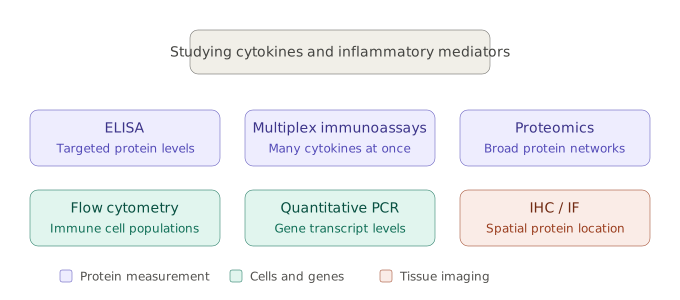
Methods for Studying Cytokines and Inflammatory Mediators
Several laboratory approaches are used to investigate the abundance, distribution, and biological activity of inflammatory signaling molecules.
Emerging Research Directions
Research on cytokines and inflammatory mediators increasingly focuses on the organization of signaling networks rather than isolated molecular measurements.
Several approaches are particularly relevant:
Single-cell analysis: Investigates differences in gene expression and cellular states across individual cell populations.
Spatial molecular profiling: Examines where inflammatory signals and cell populations occur within tissues.
Integrated multi-omics: Combines transcriptomic, proteomic, and other molecular datasets to explore relationships between biological processes.
Computational network analysis: Identifies patterns of interaction among cytokines, receptors, signaling pathways, and cellular responses.
Functional validation: Tests whether observed molecular associations correspond to measurable biological effects.

Cytokines and inflammatory mediators form an interconnected signaling network that regulates immune communication, cellular recruitment, tissue responses, and inflammatory resolution.
Understanding their individual functions is important, but their interactions, timing, and biological context are equally significant. Combining appropriate analytical methods with rigorous experimental design allows researchers to investigate inflammatory mechanisms more comprehensively.
For immunology, renal research, and rheumatology, the study of inflammatory signaling provides a valuable framework for exploring immune regulation, tissue homeostasis, and the molecular processes associated with persistent inflammation.